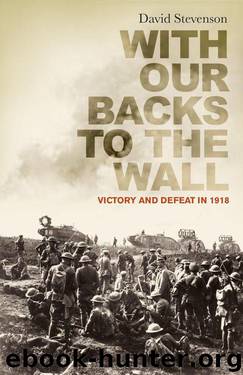
With Our Backs to the Wall: Victory and Defeat in 1918 by Stevenson David
Author:Stevenson, David [Stevenson, David]
Language: rus
Format: epub
ISBN: urn|isbn|9781846145018
Publisher: Penguin
Published: 2011-05-25T20:00:00+00:00
SHIPPING
These discussions are a reminder that immense construction, manufacturing, and repair programmes underpinned the Allies’ triumph. British mine and depth charge output trebled between 1917 and 1918; that of depth charge throwers quadrupled.158 Convoy reduced sinkings, but damage to merchant vessels remained frequent, and commercial tonnage repaired in Britain more than doubled from 202,289 in May 1917 to 467,822 in March 1918.159 In just one quarter at the end of 1917, 3,276 naval vessels were repaired and refitted. As for construction, the pre-war Anglo-German naval race continued into the conflict, and Britain won. When war broke out Britain’s superiority in capital ships had been quite narrow, but by the Battle of Jutland the ten battleships being built in 1914 were finished, and the new Queen Elizabeth class with 15-inch guns outranged the largest German calibres of 13.5 inches. The anti-submarine campaign then posed a different challenge, the imperative now being no longer battleships but destroyers and escorts. According to the Admiralty Controller, who was responsible for building, Britain had to create a ‘new navy’ of light craft, the numbers of anti-submarine vessels under construction rising from 576 in August 1917 to 848 in May 1918. During the war as a whole, the Admiralty ordered four more battlecruisers, thirty-six cruisers, and over 300 destroyers, and added in all 842 warships and 571 auxiliary vessels.160
These achievements had a cost. Although Geddes complained that the navy was losing its ‘first claim upon the resources of the nation’,161 it still enjoyed a privileged position. Britain possessed not only the Royal Dockyards but also the largest private shipbuilding industry in the world, and ‘work badges’ protected shipyard and marine engineering employees from military service. Whereas the Ministry of Munitions had to build up production for the army with a largely raw labour force, the Admiralty held on to its skilled workers, over 90 per cent of whom in 1918 were still male.162 The merchant marine also made sacrifices, and in the first half of the war commercial shipbuilding was crowded out and fell to a third of its 1913 level. In 1916, however, the incoming Lloyd George government set up a Ministry of Shipping under a tough but shrewd and public-spirited Glasgow ship owner, Sir Joseph Maclay. In May 1917 all naval and commercial building was placed under a Navy Controller, the Cabinet agreeing that before the end of 1918 merchant shipbuilding output should rise to the equivalent of 3.11 million tons per annum.163 The precondition would be increased allocations of steel and labour, and steel supplies did improve.164 Yet the crucial labour shortfall was never overcome, despite the Cabinet’s Committee on Man Power identifying shipbuilding as one of the highest national priorities.165 Britain’s shipbuilding output in 1918 reached 2.9 million gross tons, exceeding the 1913 record of 2.3 million, but merchant ship production accounted for barely half this total and remained well below target.166 Both the employers and the trade unions resisted ‘dilution’ – a temporary relaxing of the skills level required for employment
Download
This site does not store any files on its server. We only index and link to content provided by other sites. Please contact the content providers to delete copyright contents if any and email us, we'll remove relevant links or contents immediately.
| Arms Control | Diplomacy |
| Security | Trades & Tariffs |
| Treaties | African |
| Asian | Australian & Oceanian |
| Canadian | Caribbean & Latin American |
| European | Middle Eastern |
| Russian & Former Soviet Union |
The Secret History by Donna Tartt(19085)
The Social Justice Warrior Handbook by Lisa De Pasquale(12190)
Thirteen Reasons Why by Jay Asher(8909)
This Is How You Lose Her by Junot Diaz(6885)
Weapons of Math Destruction by Cathy O'Neil(6279)
Zero to One by Peter Thiel(5801)
Beartown by Fredrik Backman(5751)
The Myth of the Strong Leader by Archie Brown(5507)
The Fire Next Time by James Baldwin(5442)
How Democracies Die by Steven Levitsky & Daniel Ziblatt(5218)
Promise Me, Dad by Joe Biden(5153)
Stone's Rules by Roger Stone(5087)
A Higher Loyalty: Truth, Lies, and Leadership by James Comey(4960)
100 Deadly Skills by Clint Emerson(4924)
Rise and Kill First by Ronen Bergman(4788)
Secrecy World by Jake Bernstein(4752)
The David Icke Guide to the Global Conspiracy (and how to end it) by David Icke(4717)
The Farm by Tom Rob Smith(4507)
The Doomsday Machine by Daniel Ellsberg(4490)
